
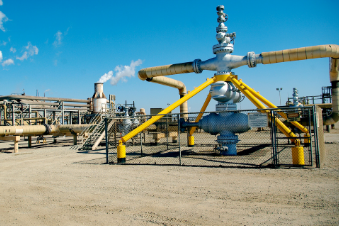
New Zealand is preparing to drill its first superhot geothermal exploration well. Todd Energy has been named preferred drilling contractor for a well at Rotokawa in the Taupō Volcanic Zone, targeting 5 to 6 km depth, with drilling expected around mid-2027. It is the first of a planned three-well programme, backed by up to $60 million from the Regional Infrastructure Fund.
The prize is significant: fluids above water’s critical point carry far more energy per well than conventional geothermal. The engineering challenge is equally significant. Here is what changes for the well itself.
1. Temperature changes every design load
Conventional New Zealand geothermal wells are drilled to around 2 to 3 km. Going to twice that depth means bottom-hole temperatures well beyond anything in the current offset database. Casing and connections must cope not only with the static temperature but with the cycle between a cold well during drilling, injection or shut-in and a hot well in production. Thermal expansion against cemented casing creates compressive loads that conventional designs do not have to carry, and connections must keep their seal and strength through repeated cycles.
2. Cement and elastomers reach their limits
Standard Portland cement loses strength at high temperature unless the formulation is engineered for it, and every annulus left uncemented becomes a place for trapped fluid to expand and load the casing. Elastomer seals in packers, wellheads and valves have hard temperature ratings that superhot conditions will test, which pushes the design towards metal-to-metal sealing wherever it matters.
3. The fluids are corrosive
Superhot fluids can carry acid gases and chlorides that attack standard tubulars and wellhead components far faster than conventional brine. Material selection becomes a first-order design decision rather than a procurement detail, and it has to be made early because specialist alloys and qualified components carry long lead times.
4. Well control and barriers need a fresh look
Higher pressures and temperatures mean the barrier philosophy, wellhead rating and kick response for a superhot well need to be designed from first principles. The international review panel for the project includes engineers from the Iceland Deep Drilling Project, which has direct experience of what these conditions do to a wellbore.
5. Integrity has to be planned for the life of the well
A superhot well will degrade differently from a conventional one. Monitoring, inspection intervals and the eventual abandonment design should be part of the original basis of design, not something worked out after the well is producing. Independent examination of the design, before spud and through operations, gives the operator and the regulator confidence that these risks have been addressed.
What this means for New Zealand
Superhot geothermal is a step-change for New Zealand’s geothermal industry, and much of the engineering it needs already exists in high-pressure, high-temperature oil and gas wells: qualified 20,000 psi wellheads, cement designed for extreme conditions, and materials selected for sour, CO₂-rich service. The task is to combine that experience with New Zealand’s deep geothermal know-how.
Superior Performance Design has designed HPHT wells to 195°C and 20,000 psi, and provides geothermal well design, independent well examination and integrity management from Auckland. If you are involved in superhot or deep geothermal wells, talk to one of our engineers or read more about our geothermal well engineering.